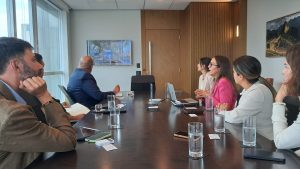
We have 4 fantastic speakers: Irene Martín, Director of Wedgewood Spain (he has been in the market for more than 40 years, he says that this sector has changed after the pandemic); David López, CEO & Co Founder of Grand Class (works with local companies, mainly in northern and central Europe and internationally, with the USA. In Madrid, mainly the MICE part. They are growing little by little, there is no need to take risks. They will continue to expand next year on the islands, taking advantage of the high season); Patricia IglesiasSales Manager & Corporate & Mice in the Hotel RIU Plaza España (its main market is the national one, among the most important international markets are the USA, France, Germany and Latin America, very powerful markets. RIU was one of the first hotels to open after the pandemic. The client identifies them by their location and by belonging to an emblematic building. This year a new client is coming in: lawyers. At the end of the pandemic, it was producers, politicians and sportsmen who pushed the hotels to go up. Pepe PueblaCEO in Technical Incentives & Incoming Group.
All three rapporteurs agree that One of the big problems in the service sector is staffing. On the one hand, Iglesias says that "a lot of confidence has been transmitted", "the staff that started has stayed and there has been talk of new incorporations". But he does not forget the problems they had in London. In Madrid, after the pandemic, priorities have changed, "it is a very beautiful sector to which you have to dedicate time", "the new generations have other rhythms and see it differently".
In addition, Lopez adds how they tackled the problem of staff shortages, from their business. They did not close during the pandemic, they offered services altruistically, they gradually incorporated workers. At the beginning, they had problems with bus drivers, they could not see a time when people would use public transport again, there was uncertainty and drivers were not taking risks, so they had serious problems recruiting bus drivers during that period. However, they had no problems recruiting "chauffeur" type drivers.
The private jet was the first service to be reinstated and to start travelling normally, it started to move before the large groups. For this reason, they could choose the staff they wanted to work with them. Martin, from his experience, says that many people have left the sector.
Martin comments, "something that has not been worked on much is working with the team".. Lopez argues that well-trained staff may be better qualified and prepared for three months than a year, which may be of no use at all. "It is clear that the most important thing
The current situation for employees is the possibility for them to grow in the company", and he argues that "improvement is inevitable".
We differentiate between preventive and curative health tourism in order to be able to approach the work strategy differently.
In the case of wellness and wellbeing, we place it in that healing division in which we understand that it is fundamental as an approach to healthy living.
In conclusion, we must work collaboratively to make it clear that health tourism generates balance in the Spanish health system, proposing from the private sector a quality service for the international client and thus helping to decongest the public health system.
SIE is developing a commission to work in this collaborative line and to be able to benefit the members who belong to our Club.